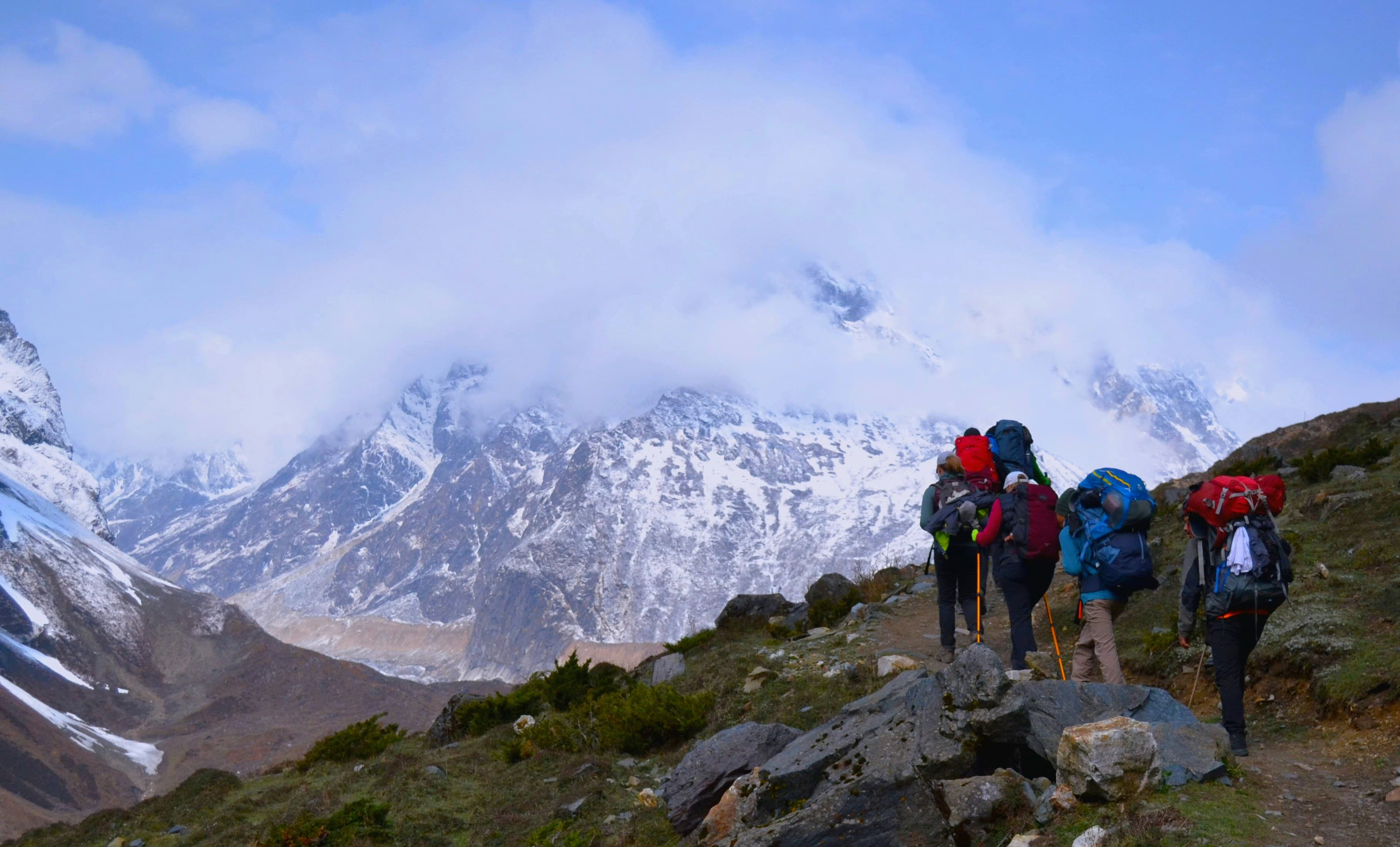
Understand the different trekking grades in Nepal—from Relatively Easy walks to Off the Beaten Track adventures—to choose the trek that matches your fitness level and preferences.
There are different kinds of treks due to Nepal's geographical diversity and varying difficulty trails. Trekking in the Himalayas requires good health and reasonable fitness, which can be enhanced through pre-trek training such as hill-walking, stair climbing, jogging, or cycling.
Treks to altitudes of about 3,000 m (10,000 ft) or less, involving easy walks up to 5 hrs/15 km per day, with occasional longer days. Suitable for anyone leading a reasonably active lifestyle.
Treks reaching 2,000 m (6,500 ft) to 3,500 m (11,500 ft), up to 6 hrs/20 km per day. Mild ascents with longer days; some hill-walking experience is desirable.
Treks to 3,000 m (10,000 ft)–4,000 m (13,000 ft) for 8 hrs/25 km per day, with possible pass crossings up to 5,000 m (16,500 ft). Requires good stamina, pre-trek training, and hill-walking experience. Typically 2–3 weeks long with steeper gradients.
Treks predominantly above 4,000 m (13,000 ft) with pass crossings between 5,000 m (16,500 ft) and 6,000 m (19,200 ft). Essential pre-trek training, high fitness level, ability to carry a backpack, and mountain-walking familiarity. May include glacier and snow crossings.
High-altitude treks above 4,000 m (13,000 ft) with multiple nights above 5,000 m (16,000 ft). Requires advanced fitness, experience on scree, snow, and ice, using ice axes, crampons, and sometimes ropes. Non-technical climbs suited for seasoned trekkers.